
Streatham has been shaped by a road. Long before Streatham High Road became the A23, an ancient route ran south from London through this part of Surrey. The name Streatham comes from Old English and is generally understood as a settlement or group of homes on the street — in other words, the settlement on the road.
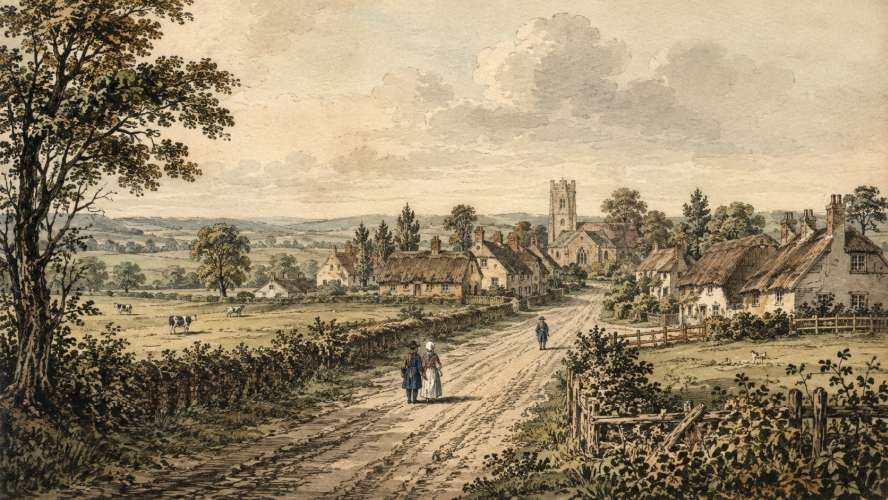
From Saxon Streatham to a medieval Surrey village
The earliest surviving documentary reference to Streatham dates from around AD 675, when land described as Totinge cum Stretham was granted to Chertsey Abbey. St Leonard’s Church records archaeological evidence of Roman activity in the locality, but the seventh-century grant is the clearest early written milestone in Streatham’s story.
After the Norman Conquest, parts of the local estates were associated with the Benedictine Abbey of Bec in Normandy. In the Domesday Book of 1086, Streatham appears as a small Surrey settlement in the hundred of Brixton. Open Domesday records 19 households spread among several landholders — a tiny community by modern standards.
The medieval village developed around the site of St Leonard’s Church. Around 1350, Sir John Ward rebuilt the parish church. The flint tower from that rebuilding survives and is regarded by St Leonard’s as the oldest standing structure in Streatham.
St Leonard’s describes the name as meaning a “cluster of houses on the street”. The Old English roots are commonly interpreted as strǣt — a road or paved street — and hām, a settlement or home.
When Streatham became fashionable
Natural mineral springs were discovered near Streatham Common in 1659. Claims were made for the medicinal qualities of the water and, during the eighteenth century, the area developed a reputation as a fashionable spa destination.
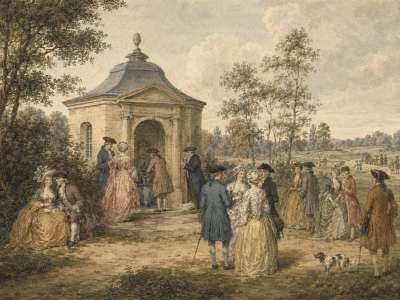
Visitors came out from London to drink the waters, walk on the Common and enjoy the cleaner air. The spa never rivalled Bath, but it helped put Streatham on the map among wealthy Londoners and contributed to the construction of large houses and estates around the village.
Samuel Johnson, the Thrales and the Streatham Worthies
In the eighteenth century, Streatham became associated with one of Britain’s best-known literary and artistic circles. Brewer, businessman and MP Henry Thrale and his wife Hester Thrale made Streatham Park a meeting place for leading figures of Georgian culture.

Samuel Johnson spent long periods with the Thrale family. Other visitors included the painter Sir Joshua Reynolds, writer Oliver Goldsmith, actor David Garrick, politician Edmund Burke, diarist Fanny Burney and biographer James Boswell.
Reynolds painted members of this circle in a group of portraits remembered as the Streatham Worthies. It is one of the strongest reasons Streatham deserves a place in the cultural history of eighteenth-century Britain.
Railways change everything
For centuries Streatham remained a village surrounded by fields, estates and common land. Its transformation into a London suburb accelerated dramatically in the nineteenth century.

The road through Streatham was already an important route south, but the arrival of the railway made daily commuting realistic. Streatham Hill station opened in 1856, and the station now known as Streatham Common followed in 1862. Large estates were gradually broken up for housing and streets of Victorian and later Edwardian homes spread across the old countryside.
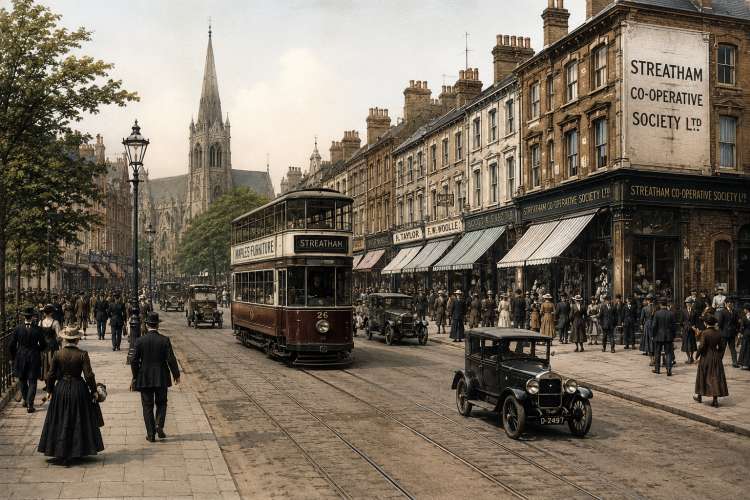
The scale of the change can be seen in St Leonard’s own history: during the long incumbency of Canon John Richard Nichol, from 1843 to 1904, the parish population grew from around 8,000 to 100,000.
A timeline of Streatham
Land at “Totinge cum Stretham” is recorded in a grant to Chertsey Abbey.
Streatham is recorded as a small settlement in Surrey, with 19 households listed across several holdings.
Sir John Ward rebuilds the parish church; its medieval flint tower survives today.
Streatham begins its development as a fashionable spa destination.
Streatham Park becomes a celebrated gathering place for Samuel Johnson and the Thrales’ literary and artistic circle.
A Georgian silk mill is established at Streatham Common, later surviving within the Sainsbury’s development.
The railway begins accelerating Streatham’s transformation from village to commuter suburb.
The station now known as Streatham Common opens, strengthening links with central London.
The great house disappears as suburban development begins reshaping the old estates.
The library is funded by local resident and philanthropist Henry Tate.
The ornate pumping station is constructed above the deep well serving the rapidly growing suburb.
The former private grounds beside Streatham Common become ornamental public gardens.
One of London’s grandest suburban theatres opens with an auditorium originally seating nearly 3,000.
The purpose-built cinema later becomes the ABC, one of Streatham High Road’s landmark entertainment buildings.
Bombing and V1 attacks kill residents and damage or destroy numerous buildings across Streatham.
Streatham becomes associated with the early development of the modern British supermarket, including Premier and an early Waitrose supermarket.
A major fire guts much of the church interior; the medieval tower survives and the church is subsequently restored.
The closure of Streatham’s famous department store marks the end of a major chapter in High Road retailing.
Two members of the public are stabbed before armed police shoot the attacker.
Streatham made, sold and pioneered
The Streatham silk mill
A Georgian silk mill was built at Streatham Common in 1820. Streatham Society research links the Wilson family business with the introduction of Jacquard technology to London. The building survived later industrial uses and was preserved during the Sainsbury’s development.
Pratts
Pratts grew from a nineteenth-century drapery business into Streatham’s great department store and later became part of the John Lewis Partnership. Its closure in 1990 became a symbol of the High Road’s changing fortunes.
Supermarket history
Streatham played an important role in the rise of self-service food retail. Premier’s Streatham store is widely cited in local histories as an early — and often described as Britain’s first modern — supermarket. Waitrose also opened its first supermarket-format store in Streatham in the 1950s.
Buildings that still tell the story

St Leonard’s Church
The medieval flint tower dates from around 1350 and is the oldest surviving structure in Streatham.

Streatham Tate Library
Opened in 1891 and funded by Henry Tate, the Grade II-listed library remains one of the High Road’s defining civic buildings.

Streatham Hill Theatre
Built in 1928–29, its vast and lavish auditorium made it one of the most impressive suburban theatres in Britain.
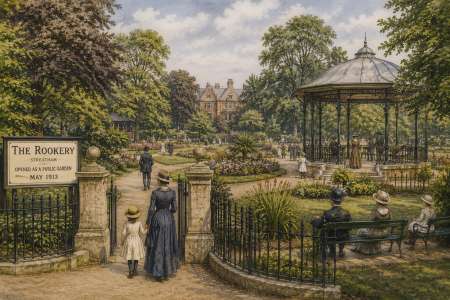
The Rookery
Opened as a public garden in 1913, the former private grounds preserve an important part of the landscape around the old mineral wells.
The man behind the Tate name lived in Streatham
Sugar magnate and philanthropist Sir Henry Tate lived at Park Hill, Streatham Common from 1880. He built a private gallery there for his art collection and opened it to visitors before establishing what became the national Tate gallery.

Tate funded public libraries across Lambeth, including Streatham Tate Library in 1891. His connection with Streatham is therefore much more than a local curiosity: one of the best-known names in British cultural life has direct roots in the neighbourhood.
Before the Tate Gallery opened in central London, Henry Tate displayed his collection at his home beside Streatham Common.
Writers, artists, politicians and performers
Streatham’s strongest historic claim to fame comes from the eighteenth-century circle around the Thrales, but the area has been connected with notable figures from many fields.

Samuel Johnson
Writer, critic and lexicographer; a frequent and important resident guest at Streatham Park.

Hester Thrale
Diarist, author and one of the central figures in the cultural life of Streatham Park.
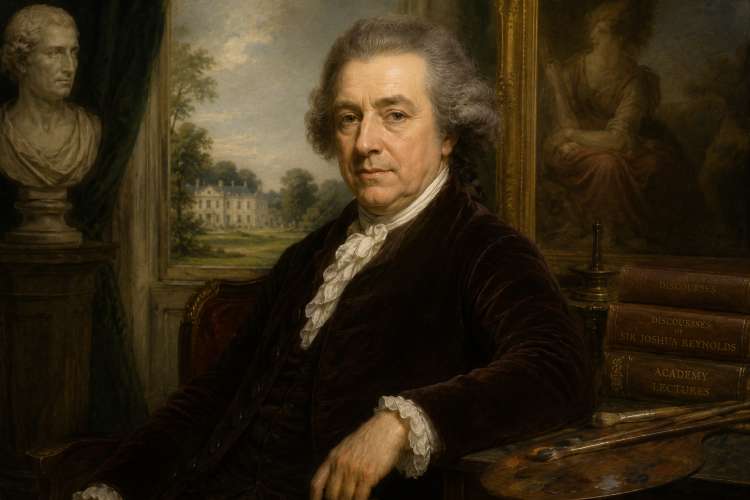
Sir Joshua Reynolds
One of Britain’s leading portrait painters and creator of the group of portraits remembered as the Streatham Worthies.
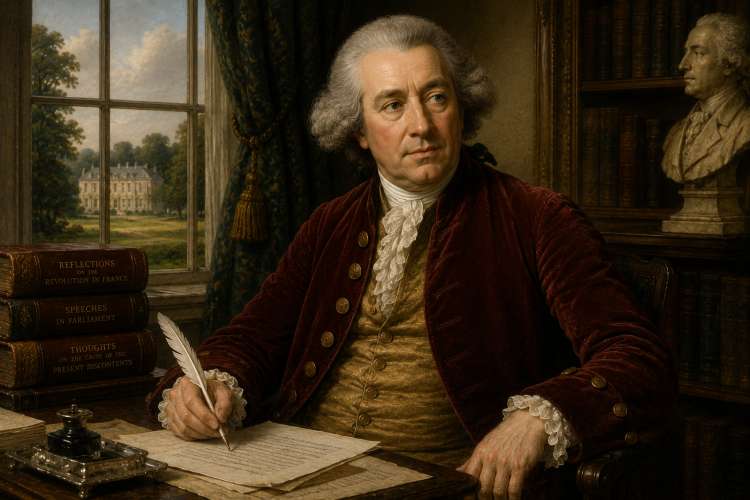
Edmund Burke
Statesman and political thinker who visited the Thrale family at Streatham Park and belonged to its celebrated intellectual circle.

David Garrick
Celebrated actor and theatre manager; one of the best-known figures linked to the social and cultural circle around Streatham Park.

Oliver Goldsmith
Writer, poet and playwright who formed part of the wider literary circle associated with Samuel Johnson and the Thrales.

Fanny Burney
Novelist and diarist closely connected with the Thrale family, whose writings helped preserve vivid accounts of life at Streatham Park.

Sir Henry Tate
Industrialist, philanthropist and art collector who lived at Park Hill beside Streatham Common and funded Streatham Tate Library.

John Major
Future Prime Minister with local connections in his youth, including time spent in Streatham and involvement with local cricket.
A piece of old Streatham survived
Streatham Common is one of the clearest surviving links with the landscape that existed before suburban development. Lambeth records suggest part of its woodland may be a relic of the historic Great North Wood.

The Common and the Rookery preserved open land while the surrounding fields disappeared beneath streets and houses. Today this landscape remains one of Streatham’s defining assets — recreation, wildlife habitat, views and local memory in the middle of South London.
New communities become part of the story
Modern Streatham has been shaped by migration from across Britain and the world. Caribbean, African, European, Asian and other communities have all contributed to the neighbourhood’s character.

The Polish community is particularly visible in and around Streatham today, through families, shops, trades, food businesses and professional services. Polish migration to London increased markedly after Poland joined the European Union in 2004, and Polish residents and businesses are now part of everyday life in this part of South London.

This is not separate from Streatham’s history. It is the latest version of a process that has happened repeatedly: people arrive, settle, build businesses and make the neighbourhood their own.
The uncomfortable side of modern Streatham
Streatham’s story is not only one of grand houses, theatres and parks. Like many parts of London, the area has experienced violent crime, antisocial behaviour and several high-profile incidents.
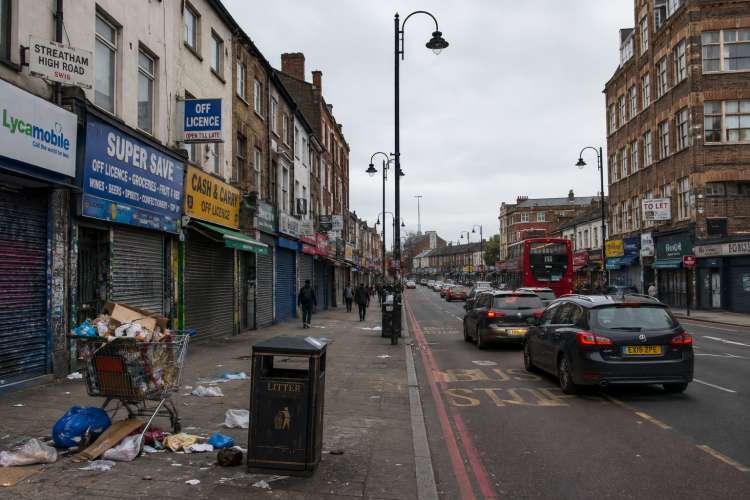
On 2 February 2020, two members of the public were stabbed during a terrorist attack on Streatham High Road before armed police shot the attacker. There have also been other fatal and serious violent incidents in the wider Streatham area in recent years.
These events should be acknowledged without allowing them to define a neighbourhood of tens of thousands of people. Safety, policing and the future of the High Road remain legitimate local concerns, but they are only one part of a much longer story.
Streatham is still changing
Streatham has been a Saxon settlement, a medieval parish, a spa, a country retreat for wealthy Londoners, a centre of Georgian literary life, a Victorian commuter suburb and one of South London’s great twentieth-century shopping and entertainment districts.

It has also survived decline, war damage, changing retail habits and the loss of buildings that once seemed permanent. At the same time, the Common, the Rookery, St Leonard’s, the Tate Library, the silk mill and Streatham Hill Theatre still connect the present neighbourhood with very different versions of its past.
The road has always been the constant. The settlement on the street became the suburb on the High Road — and more than thirteen centuries after its first recorded appearance, Streatham is still evolving.
Sources and further reading
This overview prioritises institutional and specialist local-history sources. Some popular local claims are deliberately qualified where the historical record is less clear-cut.
- St Leonard’s Church, Streatham — parish history
- Open Domesday — Streatham
- Thames Water — Streatham Wells and Pumping Station
- Historic England — Streatham Hill Theatre
- Historic England — Streatham Tate Library and Hall
- Historic England — former ABC / Regal Cinema
- Lambeth Council — Streatham Common Conservation Area Character Appraisal
- The Streatham Society — local history and heritage research